
Glass Capillaries
a precisely sized hole for one fiber
Hold the bore to a micron and the fiber has nowhere to drift. In a collimator, a ferrule, an isolator or a
circulator, the final position accuracy of that one fiber comes down to this hole.
round / square / multi-bore
tapered bore available
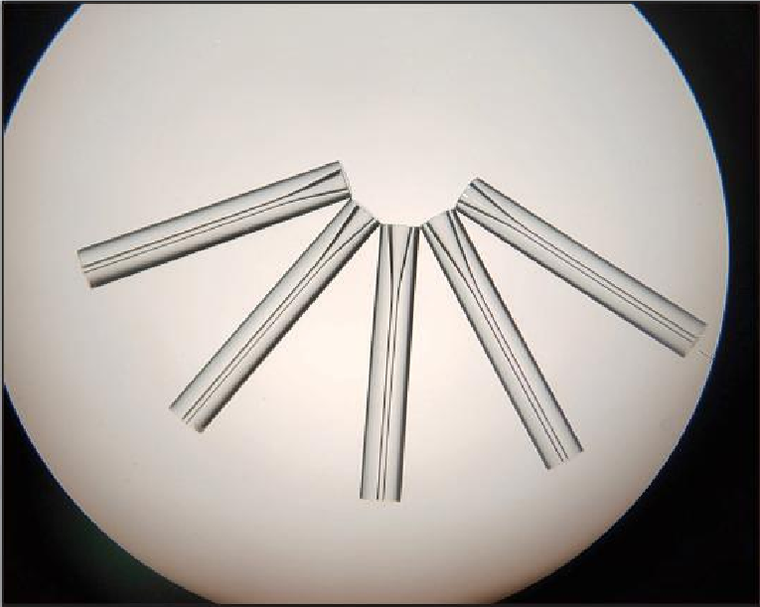
Choose by bore geometry
The bore decides what goes in: one fiber, a row of fibers, or a whole coated fiber. A tapered entry can be added to any of them.
The standard form. One bare fiber, used in collimators, ferrules and optical switches.
ID 0.060 – 0.250 mm
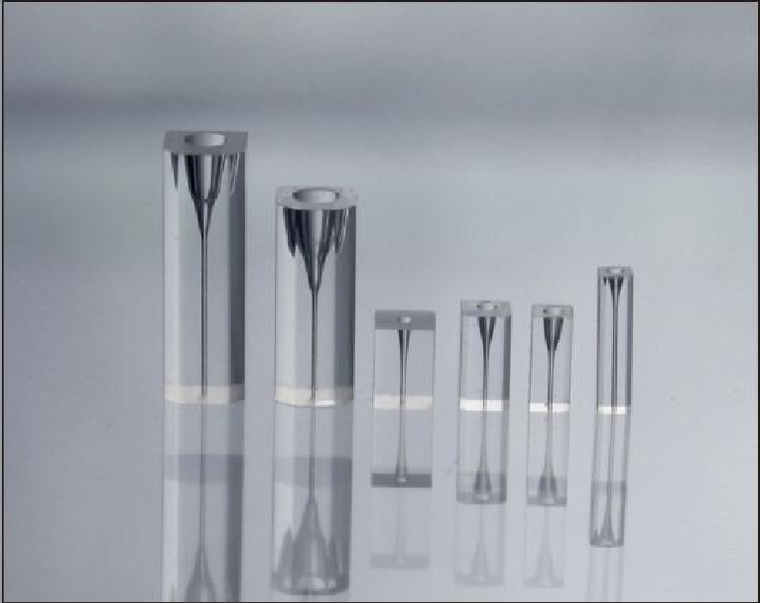
Square outside, round inside. Four flats give you a mounting and alignment datum.
square OD · round bore · optional taper
Two or four parallel bores, D-shaped or rectangular sections, for multi-core and ribbon-fiber interfaces.
2 / 4 bores · pitch to drawing
Why the bore is only 1–2 μm larger than the fiber
A 125 μm fiber goes into a 126 or 127 μm bore. One micron of clearance still lets it in; five microns let the
fiber tilt. Two microns of eccentricity becomes tens of microns of spot shift over a 20 mm working distance.
- Too tight and it will not load: bare fiber diameter itself varies by about ±1 μm, so clearance is mandatory.
- Too loose and it will not hold: adhesive fills the gap, but cure shrinkage pulls the fiber to one side — offset becomes uncontrolled.
- So the number that matters is the bore tolerance, not the bore size: ±0.001 mm and ±0.005 mm are two different products at two different prices.
A taper solves the loading problem
A conical entry gives the fiber a guide zone, so nobody spends ten minutes hunting the hole under a microscope.
Taper consistency depends on the etch process — the harder half of capillary manufacturing.
- Loading speed: manual insertion time drops by roughly an order of magnitude.
- Adhesive control: the taper acts as a reservoir; cured UV adhesive forms a strain-relief plug.
- Taper angle and length: set by bore size and assembly method; 0.5–2.5 mm taper length is typical.
What is normally possible
The table below is the industry-typical range for this product class. It tells you whether your requirement sits in normal territory.
| Item | Typical range | Notes |
|---|---|---|
| Outer diameter | 0.5 / 0.99 / 1.25 / 1.8 / 2.5 mm | Non-standard OD per drawing |
| Inner diameter | 0.060 / 0.081 / 0.126 / 0.127 / 0.250 mm | For 80 μm, 125 μm bare fiber and coated fiber |
| Bore tolerance | ±0.001 – ±0.003 mm | Precision and standard grades |
| OD tolerance | ±0.005 – ±0.01 mm | — |
| Concentricity | ≤ 0.005 mm | Directly sets fiber eccentricity |
| Bore form | straight / tapered | Taper 0.5 – 2.5 mm, angle on request |
| Cross-section | round / square / D-shape / multi-bore | Multi-bore includes 2 and 4 parallel channels |
| Material | borosilicate / quartz (JGS2 and similar) | Quartz gives better UV transmission and polishing |
| Length | cut to drawing | End faces can be ground and polished |
Scope note The table is an industry reference, not a commitment from us. The tolerances and bore forms we can actually deliver are confirmed in writing after drawing review — which is exactly why we do not hard-code the numbers here.
Where it goes
Four questions we get on capillaries
Why does bore tolerance have to reach ±1 μm?
eccentricity limit — a 2 μm gap caps it at 2 μm; a 10 μm gap lets the fiber drift to one side as the adhesive
cures. In a collimator, that offset is magnified by the working distance.
Do I need a tapered bore?
slower and yield depends on the operator. Volume assembly benefits from the guide zone, the
speed, and the adhesive reservoir. The smaller the bore and fiber, the more the taper is worth.
Borosilicate or quartz?
fiber. Quartz has a lower CTE and better thermal and chemical resistance for demanding
reliability. Both can be tapered, but the etch parameters differ — please state the material when asking for a quote.
How tight can multi-bore pitch be?
parallelism. Pitch tolerance is normally one grade looser than bore tolerance, and it depends on bore count,
bore size and spacing. For these parts, send a 2D drawing and we will quote against the drawing.
Made to drawing — not a catalogue part
Give us ID, OD, length, bore form and material, plus one cross-section drawing, and evaluation is quick.